


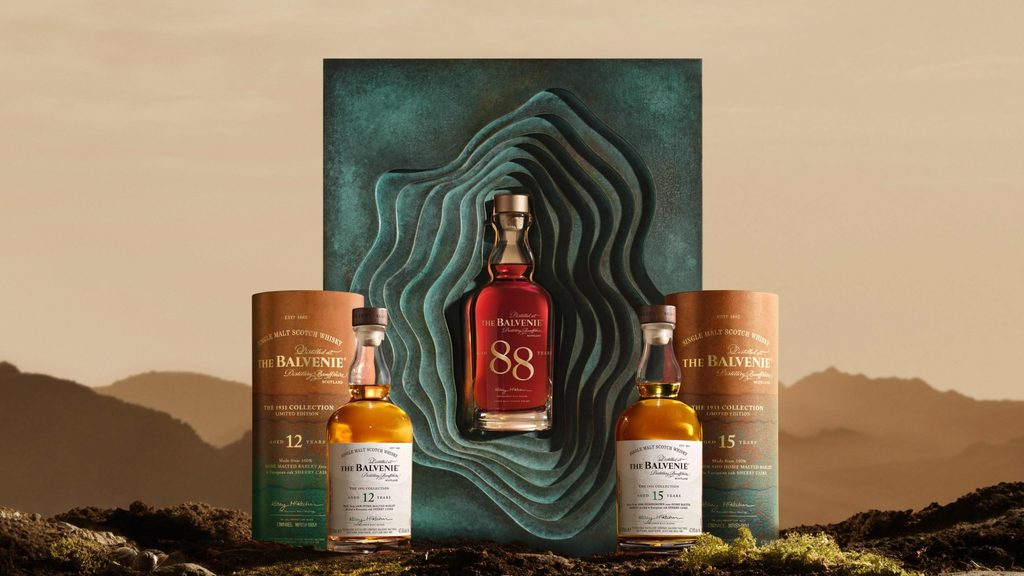
The Balvenie has unveiled an extraordinary 88-year-old single malt, setting a new record as the oldest single malt whisky ever brought to market. Only 17 bottles of the whisky exist.
The release, drawn from Cask 239, surpasses the previous record set by the 85-year-old Glenlivet released by Gordon & MacPhail in 2025.
Yet the whisky was never intended to become a record-breaker.
Filled on 5 March 1931, Cask 239 was matured in a European oak refill sherry butt sourced from Jerez. At the time, the spirit was likely destined for blending rather than being released as a Balvenie single malt. How it escaped that fate remains unknown, with surviving records offering no clear explanation.
For decades, the cask remained “hidden in plain sight”, watched over by generations of distillery workers while surrounding casks were emptied.
Knowing when to stop
The whisky’s maturation was brought to an end in 2019, when Malt Master Kelsey McKechnie decided that the spirit had reached the point where further time in oak could begin to take more away than it added.
The whisky was transferred to glass in 2019, fixing its age at 88 years old. Although almost 95 years have now passed since the cask was filled, the years spent in glass do not count towards maturation.
McKechnie approached the cask without being influenced by its remarkable age.
“I had absolutely no expectation whatsoever,” she says.
At such an extreme age, traditional assumptions about maturation become increasingly difficult to apply. The balance between wood extraction, ester development and declining alcohol strength becomes far less predictable.
“It’s absolutely doing its own thing,” McKechnie says.
Despite its age, however, Cask 239 retained a clear sense of Balvenie distillery character. Honey and toffee sit beneath notes of mint, damp bracken, worn leather and aromatic oak, while its natural bottling strength of 43.2% ABV helps preserve a surprising sense of balance.
The whisky’s character reflects its extraordinary maturation, but it is not simply dominated by oak. Buttery fudge develops into woodland notes, followed by unexpected freshness and dark fruit, creating a whisky that feels evolving rather than frozen in time.
A piece of whisky history
Cask 239 was inherited by McKechnie from her predecessor and mentor, David Stewart, who could have released it during his tenure.
Instead, its stewardship continued.
McKechnie describes her role as being the guardian of The Balvenie’s stock, and considers the release of Cask 239 to be something larger than the role of an individual Malt Master.
She says she is “exceptionally proud” that the cask was bottled during her tenure, while recognising that the whisky represents the accumulated work, patience and restraint of almost a century of distillery workers.
The 88-year-old whisky forms part of The Balvenie 1931 Collection, which also includes a 12-year-old made with 100% on-site floor-malted barley and a 15-year-old made entirely with barley grown and malted at the distillery.
Both expressions reference 1931, the year The Balvenie’s floor maltings opened.
The 88-year-old is available exclusively to private clients and collectors, at an undisclosed price, with most bottles already purchased. The 15-year-old is available exclusively through global Travel Retail, while the 12-year-old is offered in selected markets.
Records may eventually be broken again. Another cask could one day reach 89, 90 or even 100 years.
But what makes this release truly remarkable is the decision made in 2019: to recognise that the world’s oldest single malt was, simply, old enough.


